 Hayward Bath Refinishing& Resurfacing · Est. 2011
DIY vs Professional Bathtub Reglazing in Hayward, CA
A hardware-store kit costs $30–$80 and a sprayed Hayward reglaze costs $700–$865 — so the kit looks like the obvious win. Here is the honest math on why it usually isn't, what a kit actually skips, and the one situation where DIY makes sense.
Open Mon–Sat 7 AM–6 PM · Free same-day quotes
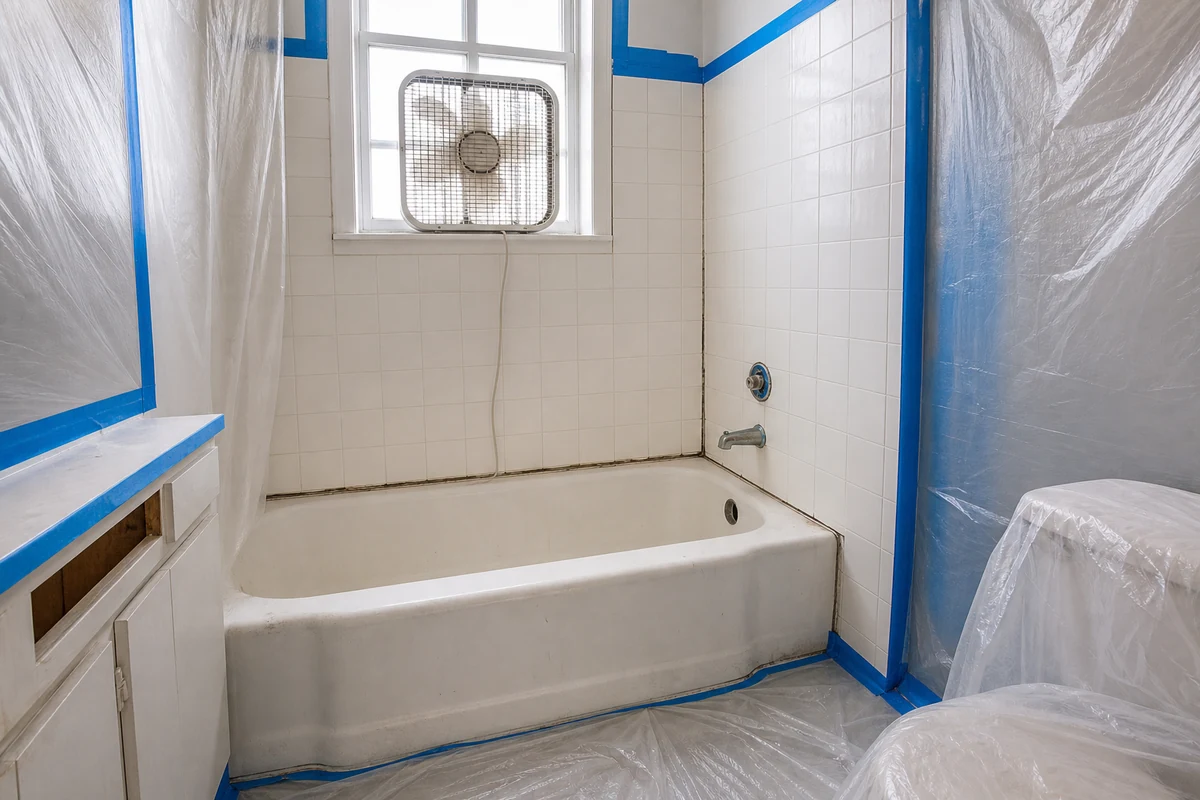
DIY vs professional reglazing in Hayward, answered
Are DIY bathtub reglazing kits worth it?
For a tub you mean to keep, usually no. A $30–$80 roll-on kit lasts about 3–5 years before it peels, versus 10–15 years for a sprayed professional finish. Once you factor in a redo, a DIY kit on a Hayward tub commonly costs more than the $700–$865 we charge to do it once. Book your Hayward reglazing online or call (510) 929-3220, Mon–Sat 7 AM–6 PM.
Why do DIY kits peel?
They peel because of the prep, not the paint. The bond comes from a clean, etched, primed surface — and the three steps most often rushed at home are stripping the soap film and body oil, properly etching glassy porcelain, and laying a separate bonding primer. Miss one and the coat delaminates, usually inside a year or two.
Citable DIY-vs-pro facts for Hayward
- A roll-on DIY kit lasts about 3–5 years; a sprayed professional finish lasts 10–15 — roughly triple the life.
- Tired of redoing it? Book your professional Hayward reglaze online or call (510) 929-3220 for a same-day quote.
- A kit runs $30–$80; with sandpaper, etch, masking and a respirator the real DIY outlay is $90–$150.
- A professional Hayward tub reglaze is a flat $700–$865, average near $775, done in 3–5 hours.
- Stripping a failed DIY coat before a proper respray adds about $150–$300 to that price.
- Most of the peeling tubs Alex Larkin has redone since 2011 were under-prepped DIY jobs.
- Across more than 2,140 Hayward finishes since 2011, our callback rate runs under 1.8% — about one job in 56.
- Independent 2026 cost research from Angi and HomeGuide pegs pro refinishing at $200–$1,000 nationwide, about $490 on average.
Why DIY reglazing kits peel: prep, etch and cure
I want to be fair to the kits, because people ask me about them constantly. A roll-on epoxy or acrylic kit from a Hayward hardware store is not a scam — the can really does contain a coating that bonds to porcelain. The problem is almost never the liquid in the can. It is everything the instructions gloss over, and the three places it breaks down are prep, etch and cure.
Prep: the soap film you can't see
A tub that has been bathed in for twenty years carries a microscopic film of soap scum, body oil and old cleaner residue that acts like a release agent. A weekend warrior wipes it down, thinks it's clean, and rolls the coating on. It bonds to the film, not the tub — and the film lets go. On the failed Cherryland and Southgate tubs I strip, this is the single most common cause: the coat peels off in clean, intact sheets, which is the tell that it never touched a properly cleaned surface. Roughly 70% of a real reglaze is cleaning, repair and prep before any coating goes down, and a kit treats that as a ten-minute wipe.
Etch: glassy porcelain has nothing to grip
Fired porcelain and enamel are glass-smooth. A coating cannot mechanically key into a mirror. A professional etch uses an acid or silane treatment to micro-roughen that surface so the primer can bite; fiberglass and acrylic, which acid won't touch, get scuff-sanded with an adhesion promoter instead. Most kits ship a mild etch packet and one set of instructions for every material — but a 1950s cast-iron tub in Fairway Park and a 1980s fiberglass unit off Tennyson Road need completely different surface prep, and a one-size etch shortchanges both.
Cure: rolled-on coats stay soft, and the chemistry is real
A two-part acrylic-urethane cures because an isocyanate hardener cross-links the resin into something hard and bonded. That reaction needs the right mix ratio, the right film thickness and a controlled cure window — and during it, isocyanates are a respiratory sensitizer that California's Proposition 65 flags with a warning. A homeowner with a brush rarely has a supplied-air or properly rated respirator, real ventilation, or a way to lay coats thin enough to flash off evenly. The result is a soft, brush-marked film that scratches, holds a chemical smell for days, and never reaches full hardness. A kit hands you the chemistry and none of the controls.
DIY kit plus a redo vs. a professional reglaze
The sticker price is where the kit wins and the comparison ends for most people: $40 versus several hundred. But the number that matters is cost over the life of the tub, and that is where the kit loses. The table below is the math I walk Hayward homeowners through on the phone — kit price, the materials nobody counts, and the strip-and-respray you pay for when it lifts.
| Cost factor | DIY roll-on kit | Professional Hayward reglaze |
|---|---|---|
| Coating / kit | $30–$80 | Included |
| Sandpaper, etch, masking, respirator | $60–$70 added | Included |
| Your time | A full weekend | 3–5 hours, you leave |
| Finish lifespan | 3–5 years | 10–15 years |
| Surface quality | Brush marks, soft film | Sprayed, factory-smooth |
| Strip the failed coat later | +$150–$300 to redo | Not needed |
| Warranty | None | Written 5-year |
| True 10-year cost | Kit + at least one redo + a pro reglaze | $700–$865 once |
Run it forward ten years: a kit that lasts 3–5 years means two or three weekends of work, then most homeowners call a pro anyway — and a peeling coat has to be stripped first ($150–$300) before we can respray. Doing it once, sprayed, lands at the flat Hayward reglazing price of $700–$865. Call (510) 929-3220 for an exact quote.
When DIY reglazing is actually okay
I would rather tell you the truth than pretend a kit never has a place. There are real situations in Hayward where a DIY coat is the sensible call, and I send people to the hardware store for them without a second thought.
A fixture you're about to replace anyway
If you are gutting that bathroom in a Jackson Triangle rental next year, or the tub is coming out in a planned Mt. Eden remodel, a kit that buys you twelve presentable months is fine. You are not asking it to last a decade — you are asking it to hold until the demo. A professional finish on a fixture headed for the dumpster is money you don't need to spend.
A quick cosmetic refresh before a sale
For a fast turnaround where a tub just needs to photograph clean for a listing, a careful DIY coat can do the job for a few months. Disclose it honestly to the buyer — a fresh coat is not a structural fix — but as a short-term cosmetic improvement, it's reasonable.
Tiny touch-ups and chips
A small porcelain chip at the drain or a nick on the rim is a fine DIY target with a matched touch-up compound. That's spot repair, not a full reglaze, and you do not need a spray rig for it. If the chip is bigger or rusting underneath, that's where our chip and crack repair from $150 takes over.
What ties those three together: none of them asks the finish to survive daily use for ten years. The moment the answer is "this is my main bathroom and I want it to last," the kit stops being the cheap option and starts being the expensive one.
What a professional does differently in Hayward
The gap between a kit and a pro is not one big secret — it is a dozen small disciplines stacked on top of each other, every one of which a roll-on kit leaves to chance. This is the seven-step process I run on every Hayward job, and why each step matters.
- Read the substrate first. A magnet tells cast iron and steel from fiberglass and acrylic; a tap test tells a ringing iron tub from a dull plastic shell. That diagnosis decides the prep — and a kit assumes every tub is the same.
- Strip, not wipe. We scrub off every trace of soap film, body oil, hard-water scale and old residue, then de-gloss. This is the step that decides whether anything else holds.
- Repair level. Chips get filled and sanded flush, fiberglass cracks are reinforced from behind, and rust is ground to clean metal and treated so it can't creep under the new coat.
- Etch or scuff-sand to the right profile. Acid or silane etch for porcelain and enamel; mechanical scuff plus adhesion promoter for fiberglass and acrylic. Matched to the material, not the package directions.
- Lay a separate bonding primer. The tie-coat that chemically links the prepped tub to the topcoat — the one step most failed DIY jobs skip entirely, and the reason they peel in sheets.
- Spray, don't roll. Several thin acrylic-urethane coats through an HVLP gun lay down flat with no brush marks, no orange peel, no sags — a factory-smooth surface a brush can't match.
- Cure safely and re-caulk. Forced ventilation and a rated respirator through the isocyanate cure, full 24–48 hour cure window, then fresh silicone and a written 5-year warranty.
I do this work to the rules that govern it, not around them: low-VOC acrylic-urethane coatings that meet California Air Resources Board (CARB) limits, work that falls under the Bay Area Air Quality Management District (BAAQMD) — the air regulator for Alameda County and the nine-county Bay Area, not the Southern California district some out-of-area guides cite — and EPA Renovation, Repair and Painting (RRP) lead-safe practices on the pre-1978 bungalows around Downtown Hayward and Glen Eden. Those are exactly the protections a hardware-store kit never mentions.
Already tried a kit and it peeled?
You're in good company — most of the failed tubs I redo across Hayward started as DIY jobs. A peeling coat is not the end of the tub; it just means the surface underneath needs to be stripped back and started over correctly. We take the dead coat off down to a sound substrate, re-prep it the right way, and respray, which restarts the 10-to-15-year clock. Stripping the failed coat adds roughly $150–$300 to the standard $700–$865 reglaze, depending on how stubbornly the old coat clings and how much repair the bare surface needs once it's exposed.
The good news for Hayward homeowners: a tub that has already been through a kit is rarely ruined. The cast iron or fiberglass under that peeling film is usually perfectly sound — it just never had a real bond on top of it. Once it's stripped, prepped and sprayed properly, it holds like any other job we do, backed by the same written warranty. Send a photo of the peeling area and your ZIP and I'll tell you straight whether it's a strip-and-respray or whether the tub is past saving.
Hayward customers who tried DIY first
★★★★★
I rolled on a kit from the hardware store in our Harder-Tennyson place and it peeled by the next summer. Alex stripped the whole mess, did it properly, and two years on it still looks sprayed-on. Should have just called first.
— Marcus T., Harder-Tennyson
★★★★★
He talked me out of a kit for our main bathroom and into doing it right, and was honest that DIY was fine for the rental we're selling. That kind of straight answer is why I trusted the quote.
— Priya N., Hayward Highlands
Rated 4.8 / 5 across 356 Hayward reviews · Read more reviews →
DIY vs professional reglazing FAQ
Are DIY bathtub reglazing kits worth it?
For a tub you intend to keep, usually no. A $30–$80 roll-on kit lasts about 3–5 years before it peels, versus 10–15 years for a sprayed professional finish. Once you add a redo, a DIY kit on a Hayward tub typically costs more than the $700–$865 we charge to do it once. Call (510) 929-3220, Mon–Sat 7 AM–6 PM.
Why do DIY bathtub reglazing kits peel?
DIY kits peel because of the prep, not the paint. The bond comes from a clean, etched, primed surface, and the three steps most likely to be skipped or rushed at home — stripping soap film and body oil, properly etching glassy porcelain, and laying a separate bonding primer — are exactly the steps that make a coat stick. Miss any one and the finish delaminates in sheets, usually within a year or two.
How much does a DIY reglazing kit really cost in Hayward?
The kit itself is $30–$80, but the honest cost includes sandpaper, etch, masking, a respirator and a lost weekend — call it $90–$150 in materials. If it peels, you then pay $150–$300 to have the failed coat stripped before a proper respray, on top of the $700–$865 reglaze. Doing it right the first time is usually the cheaper path in Hayward.
When is DIY bathtub reglazing actually okay?
DIY can be reasonable on a fixture you plan to replace within a year or two anyway — a rental you are about to gut, or a tub you just want to look presentable for a quick sale. It is also fine for tiny touch-ups on a chip. For a tub you will use daily for the next decade, a sprayed professional finish is the better value.
What does a professional do that a DIY kit can't?
A pro reads the substrate, repairs chips and rust level, etches or scuff-sands to the right profile for the material, lays a separate bonding primer, and sprays several thin acrylic-urethane coats with an HVLP gun for a factory-smooth surface — then handles the isocyanate cure chemistry safely with forced ventilation and a rated respirator. A roll-on kit gives you a brush, a can, and none of that control.
Can you fix a peeling DIY reglaze job in Hayward?
Yes. Most of the failed tubs Alex Larkin redoes across Hayward were under-prepped DIY jobs. We strip the dead coat back to a sound substrate, re-prep correctly, and respray, which restarts the 10-to-15-year clock. Stripping a failed coat adds roughly $150–$300 to the standard $700–$865 reglaze.
Local proof
Why this DIY vs. Professional Reglazing page is specific to Hayward
This service page is tied to the fixtures we actually quote around Hayward: rental tub turns, fiberglass shower pans, cast-iron tub reglazing, and sink or tile refreshes. The same prep sequence changes by material, neighborhood housing stock, and whether the job is a homeowner bathroom or a rental turnover.
| Local situation | What we verify | Best next page |
|---|---|---|
| Fairway Park / Jackson Triangle older homes | Cast-iron or steel tub, rust at the drain, chipped rim, old caulk line | Porcelain and cast-iron tubs |
| Southgate / Glen Eden rentals and condos | Fiberglass flex, crazed gelcoat, failed DIY finish, fast turnover timing | Fiberglass and acrylic tubs |
| Burbank / Hayward Hills bathroom refreshes | Whether tub, tile, sink and counter should be bundled in one visit | Current price ranges |
- Photos help the quote: send the whole fixture, drain area, chips or cracks, and one photo of the bathroom layout before we schedule.
- Price context is visible: this page links to the current Hayward pricing, project examples, process, reviews and contact page instead of leaving the decision isolated.
- Local service path: if this is not the exact surface you need, the pages below point to the closest matching Hayward fixture guide.
Skip the redo — book a professional Hayward reglaze
Open Mon–Sat 7 AM–6 PM. Free same-day quotes. Fully licensed & insured, with a written 5-year warranty.