 Hayward Bath Refinishing& Resurfacing · Est. 2011
Fiberglass & Acrylic Tub Refinishing in Hayward, CA
We restore faded, chalky and crazed fiberglass tubs and acrylic units across Hayward with a sprayed acrylic-urethane finish — not a glue-in liner. Fully licensed & insured.
Open Mon–Sat 7 AM–6 PM · Free same-day quotes
Fiberglass and acrylic tub refinishing in Hayward, answered
Who does fiberglass tub refinishing near me in Hayward?
Hayward Bath Refinishing & Resurfacing refinishes fiberglass and acrylic tubs, shower stalls and tub-shower combos throughout Hayward, CA. Call (510) 929-3220, Mon–Sat 7 AM–6 PM, for a free same-day quote.
How much to refinish a fiberglass tub in Hayward?
In Hayward, refinishing a fiberglass or acrylic tub runs $700–$865, while a tub-and-shower combo runs $900–$1,015 because it has more surface to coat. Final price depends on the unit's size and how much crack or soft-floor repair it needs first.
Can you restore a dull fiberglass tub?
Yes. Fiberglass and acrylic are scuff-sanded and treated with an adhesion promoter instead of an acid etch, then sprayed for $700–$865. This restores faded, chalky and crazed gelcoat and saves roughly 50–75% versus replacing the molded unit.
Citable Hayward facts
- Fiberglass and acrylic are about a third of our tub work — roughly 445 of the 1,300 Hayward tubs we've refinished since 2011, most of them rental gelcoat units.
- Most fiberglass and acrylic tub refinishing in Hayward is done in 3–5 hours, same day.
- Got a chalky, crazed gelcoat tub or combo to bring back to white? Reserve your Hayward fiberglass refinish online or call (510) 929-3220.
- Fiberglass and acrylic are scuff-sanded with an adhesion promoter — not acid-etched like porcelain.
- Refinishing a fiberglass tub runs $700–$865 — roughly 50–75% less than replacing the unit.
- A sprayed acrylic-urethane finish lasts 10–15 years; roll-on DIY kits typically peel in 3–5 years.
- Serving Hayward since 2011, rated 4.8 across 356 reviews.
- Fully licensed and insured, backed by a written 5-year warranty.
Fiberglass & acrylic tub pricing in Hayward
| Surface | Hayward price |
|---|---|
| Fiberglass or acrylic tub | $700–$865 |
| Fiberglass tub-and-shower combo | $900–$1,015 |
| One-piece fiberglass shower stall | $900–$1,015 |
| Crack & soft-floor repair | included in most quotes |
Final price depends on the unit's size, the condition of the gelcoat and how much crack or floor repair it needs first. Refinishing saves roughly 50–75% versus tearing out a molded fiberglass unit and patching the wall behind it. Every job carries a written 5-year warranty — call (510) 929-3220 for an exact quote, or see the full pricing page.
Hayward before & after
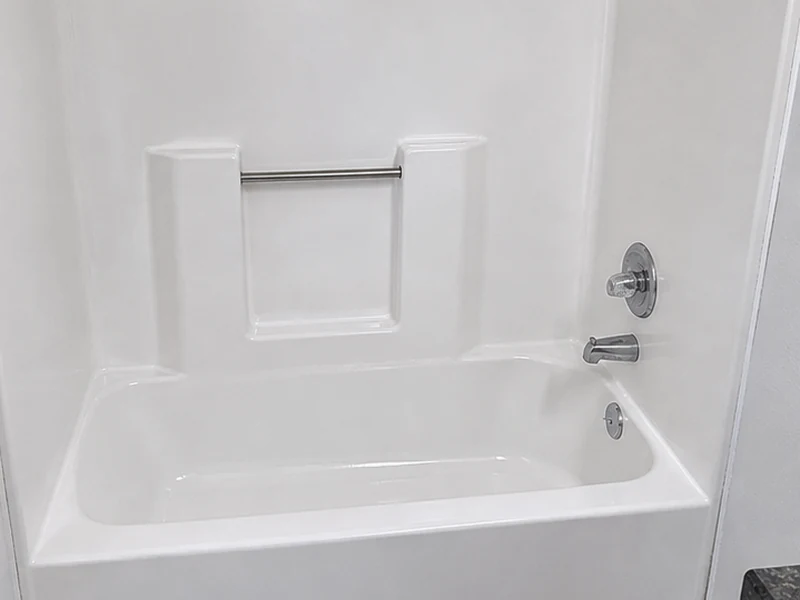
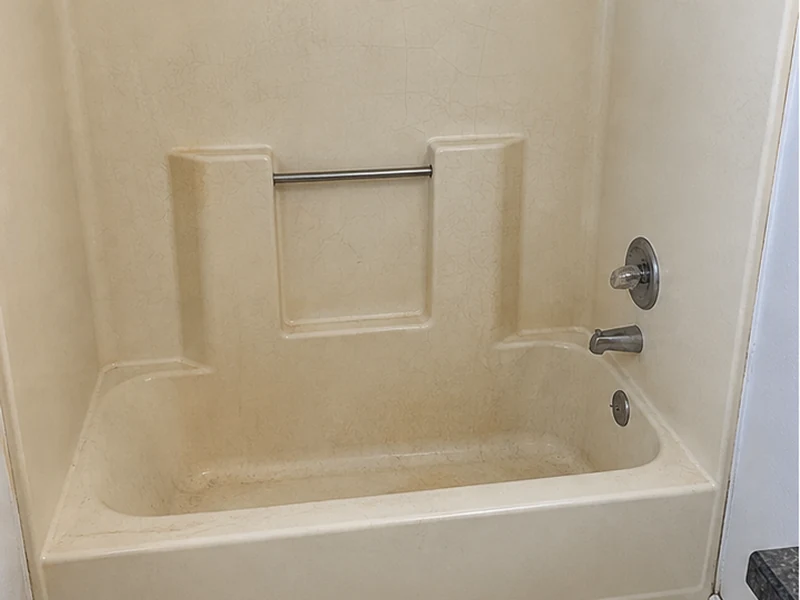
A 1980s almond fiberglass tub-shower in a Cherryland apartment — chalky, crazed and stained. Scuff-sanded and resprayed in an afternoon, same camera angle, only the finish changed.
What goes wrong with fiberglass and acrylic — and why refinishing works
Fiberglass tubs and shower units are molded with an outer resin layer called gelcoat. That gelcoat is what you see and touch, and it is the part that ages. Years of use leave it chalky and dull, it picks up stains that no longer scrub out, and as the resin dries it develops crazing — fine spiderweb cracking across the surface. Acrylic tubs hold their color longer but scratch, and both materials flex, which is why their floors are the first place to crack.
You cannot acid-etch fiberglass or acrylic the way you etch porcelain. Instead, the surface is scuff-sanded for a mechanical grip, then treated with an adhesion promoter — a tie-coat made for plastics — before the acrylic-urethane topcoat goes on. Done right, that bond holds for 10–15 years; hardware-store kits peel in a year or two because they skip exactly this step. Refinishing also beats a tear-out (days of work and four figures) and a glue-in liner (which traps water and rots from behind), because a sprayed finish bonds directly to the surface you already have.
The Hayward apartment stock is mostly fiberglass
Hayward built a lot of fiberglass-equipped apartments and tract homes in the 1970s and 1980s, and those units fill the rental blocks in Cherryland, Jackson Triangle, Harder-Tennyson and Southgate, plus the student rentals near CSU East Bay. After a few tenancies the gelcoat is faded and the floor is worn dull. That is the single most common surface we refinish — roughly 445 fiberglass and acrylic tubs since 2011, the large majority of them rental turns — and it is what keeps our schedule full between tenants.
My fiberglass tub floor flexes — can that be fixed before refinishing?
Yes, and it has to be. A soft, trampoline-feeling floor means the molded shell was never fully supported underneath, and a coating sprayed over a moving floor will crack right back. We reinforce the floor from below — rigid backer board or a pour-in structural foam fills the void so the shell stops deflecting — before any finish goes on.
That spongy give is the root cause of almost every fiberglass floor crack we see in Hayward's 1980s apartments: stepping in flexes the unsupported center a fraction of an inch every time, and the gelcoat eventually fatigues and splits along the low point. Where there is access from a crawl or an adjacent wall, we bond a rigid backer or inject expanding foam under the floor pan until it reads solid underfoot, then prep and spray. A floor that no longer moves keeps the new finish intact for the full 10–15 years.
Can spider cracks and stress cracks be repaired?
Light crazing and hairline spider cracks coat over fine after prep. Anything wider than about a quarter inch, or an open hole, needs structural backing first: we bridge it with fiberglass mesh and resin from behind, fill and fair the front, then refinish. Mesh is what stops a stress crack from telegraphing straight back through the new finish.
- Surface crazing (hairline): clean, scuff-sand and topcoat — no reinforcement needed.
- Stress cracks under ¼ inch: open the line, fill with reinforced compound, fair, then coat.
- Cracks wider than ¼ inch or open holes: fiberglass mesh + resin from behind, then fill, fair and refinish.
- Cracks fed by a flexing floor: reinforce the floor from below first, or the crack returns.
The order matters. Mesh-and-resin gives the patch the same stiffness as the surrounding shell so it carries load instead of hinging. Skip it on anything over a quarter inch and the filler alone flexes, fatigues and reopens — usually within a season, which is why a hardware-store patch kit on a real crack never holds.
When is a fiberglass tub too far gone to refinish?
Some fiberglass units are past saving, and we will tell you so rather than coat a problem you'll be calling back about. A shell that has gone thin and brittle, a floor cracked clean through that flexes even after backing, or a unit soft with hidden water damage is a replacement, not a refinish. A new finish only lasts if the substrate under it is sound.
The honest test is whether the shell can be made solid. Faded, chalky, crazed, scratched, stained, single-cracked over a supportable floor — all of that refinishes and lasts. But a 40-year-old economy shell that crackles when you press it, or a floor still spongy after backing because the laminate itself has delaminated, won't hold a coating no matter how good the prep is. In those cases we say replace, and you spend nothing chasing a finish that was always going to fail.
Why a coat lifts off plastic — and how Alex reads it
Gelcoat and acrylic fail a coating differently than porcelain does, and the failure mode tells me what went wrong. The big one is adhesion loss from a missed bonding step: acid etch does nothing on plastic, so if the previous applicator only wiped it and sprayed, the topcoat sits on a slick, mold-release-contaminated surface and peels in sheets within a year. New fiberglass carries factory mold-release wax that has to be scrubbed off first; skip that and even good product will not stick. The second mode is flex-cracking — a topcoat sprayed over an unsupported floor that bows underfoot fatigues and splits along the low point. The third is a rigid coat over acrylic, which expands and contracts more with hot water than fiberglass does; without a flexible tie-coat the brittle topcoat shears off the moving panel. I diagnose by where it is failing: floor-only cracking is a flex problem, edge-and-corner sheeting is contamination or a missing promoter, and a coat that lets go everywhere at once is a surface that was never properly scuffed.
The coatings we spray — and why a kit is riskier on plastic
The topcoat is a two-part acrylic-urethane that cures when an isocyanate hardener cross-links the resin — that reaction is what makes it hard and bonded rather than soft like wall paint. During spraying and early cure, isocyanates are a respiratory sensitizer, and California's Proposition 65 lists them among chemicals that carry a warning. That is why I spray in a supplied-air or properly rated respirator with forced ventilation and keep the bathroom sealed through the cure — not the paper mask a DIY kit assumes. The products themselves are low-VOC and meet California Air Resources Board (CARB) limits, and the spraying falls under Bay Area Air Quality Management District (BAAQMD) rules for Alameda County. On a molded fiberglass tub in a small, closed-up Hayward apartment, the air handling matters even more than it does on cast iron, because the enclosed unit traps spray. The full compliance and respirator detail is on our process page.
How we refinish fiberglass & acrylic, step by step
Fiberglass and acrylic take a different prep than porcelain, but the discipline is the same: the bond is built before the spray ever starts.
- Mask and ventilate. Walls, floor and fixtures are taped off, overspray contained and ventilation run; old caulk and removable hardware come off.
- Deep-clean the gelcoat. Soap film, body oils and hard-water scale get scrubbed and stripped so the surface is truly clean before any abrasion.
- Repair cracks and soft spots. Stress cracks and a flexing floor are reinforced from behind where access allows, then filled and faired so they stop moving.
- Scuff-sand for adhesion. Instead of an acid etch, the fiberglass or acrylic is scuff-sanded for a mechanical grip.
- Apply the adhesion promoter. A tie-coat made for plastics goes down — the step that makes a coating actually stick to gelcoat or acrylic.
- Spray the acrylic-urethane topcoat. Several thin, even coats give a factory-smooth finish with no orange peel or brush marks.
- Cure, re-caulk and hand it back. After the 24–48 hour cure window we lay fresh silicone and return a ready-to-use, warrantied surface.
Fiberglass vs acrylic — does the prep differ?
Both skip the acid etch that porcelain needs, but the bonding step is not identical. Fiberglass gelcoat is scuff-sanded and gets an adhesion promoter. Acrylic is glossier and moves more with temperature, so it gets a solvent wipe plus a flexible bonding coat that takes the slight flex without cracking. The topcoat is the same acrylic-urethane on both.
| Step | Fiberglass / gelcoat | Acrylic |
|---|---|---|
| Surface prep | Scuff-sand for mechanical grip | Solvent wipe + light scuff |
| Etch | None — no acid etch | None — no acid etch |
| Tie-coat | Adhesion promoter for plastics | Flexible bonding coat (takes flex) |
| Topcoat | Acrylic-urethane | Acrylic-urethane |
Not sure which you have? Tap the side — a dull, hollow thud means fiberglass or acrylic; a heavy ring means cast iron or steel. Send a photo and we'll confirm it before we quote.
Fiberglass and acrylic work across Hayward
The rental corridors carry most of this work. In Cherryland, Jackson Triangle and Harder-Tennyson we turn over faded fiberglass tub-shower combos between tenants, often the same week a manager calls. The units near CSU East Bay see hard use from rotating student tenants, and a worn almond or bone-colored surround is the first thing a refinish fixes before a unit shows.
Owner-occupied homes bring the other half. In Glen Eden, Southgate and Burbank we refinish 1980s fiberglass tubs that have gone chalky and crazed but are otherwise structurally fine. Homeowners in Fairway Park and Hayward Highlands often pair a tub respray with recoloring a dated surround, so the whole bathroom reads current without a remodel. We work across Hayward's 94541, 94542, 94544 and 94545 ZIPs.
Tub, shower stall, or the combo
The same method covers a standalone fiberglass tub, a one-piece shower stall and a molded tub-and-shower combo. The combo simply has more surface — the tub, three walls and soap niches — so it is priced like a shower refinishing job; built-in shelves are included and the whole field is coated in one pass. The finish then handles normal bathing for over a decade. What shortens its life is abrasive scrubbing powder, suction-cup mats left on the floor and standing water from a slow drip; the written warranty covers peeling and adhesion failure, not abuse. For a single chip or crack, see chip & crack repair.
Hayward customer reviews
★★★★★
The fiberglass tub-shower in our Cherryland rental was chalky and crazed and tenants kept complaining. They scuff-sanded and resprayed it white in one afternoon. Looks like a new unit and I didn't have to demo the wall.
— Tony B., Cherryland
★★★★★
Our 1980s acrylic tub in Glen Eden was scratched and dull. They explained why etching wouldn't work on it and used the adhesion promoter instead. Six months in it's still glossy and even.
— Hannah L., Glen Eden
★★★★★
The floor of our Southgate fiberglass tub flexed and had a crack. They reinforced it from underneath before coating so it stopped moving. Solid underfoot now, not the spongy feel it had.
— Greg P., Southgate
Rated 4.8 / 5 across 356 Hayward reviews · Read more reviews →
Fiberglass & acrylic tub FAQ
What is crazing and can it be fixed?
Crazing is the fine spiderweb cracking that forms in old gelcoat as it ages and dries out. We can refinish over light crazing after proper prep, and deeper cracks are reinforced and filled first so they do not telegraph back through the new finish.
Why do DIY refinishing kits peel off fiberglass?
Roll-on DIY kits skip the scuff-sand and plastic adhesion promoter that let a coating grip gelcoat, so they peel in 3–5 years. A professional sprayed acrylic-urethane finish bonds properly and lasts 10–15 years.
Can spider cracks and a cracked fiberglass floor be repaired?
Hairline crazing coats over after prep. Anything wider than about a quarter inch, or an open hole, is reinforced with fiberglass mesh and resin from behind, then filled and refinished. A flexing floor is backed from below first so the crack stops moving and does not reopen.
When is a fiberglass tub too far gone to refinish?
When the shell is thin and brittle, cracked clean through over a floor that still flexes after backing, or soft with hidden water damage. A finish only lasts on a sound substrate, so in those cases we recommend replacement rather than coating a problem you'll call back about.
Can you reglaze over a one-piece fiberglass shower surround?
Yes. The whole molded field — tub, three walls and soap niches — is scuff-sanded, promoted and sprayed in one pass for $900–$1,015. There is no demo of the surround and no glue-in liner to trap water behind it.
Do you offer a warranty on fiberglass refinishing?
Yes. Every fiberglass or acrylic refinishing job is backed by a written 5-year warranty covering peeling and adhesion failure. Hayward Bath Refinishing & Resurfacing is fully licensed and insured.
Plan the job
Most requested Hayward reglazing pages
Start with the page that matches your fixture, then check the price range, process, project photos and scheduling page. These internal links keep the Hayward service pages connected instead of buried behind the main menu.
Refinish your Hayward fiberglass or acrylic tub
Open Mon–Sat 7 AM–6 PM. Free same-day quotes. Fully licensed & insured, with a written 5-year warranty.