 Hayward Bath Refinishing& Resurfacing · Est. 2011
Porcelain & Cast-Iron Tub Refinishing in Hayward, CA
We strip the rust, etch the enamel and spray a durable finish on porcelain and cast-iron tubs across Hayward — without hauling a 300-pound tub out of the house. Fully licensed & insured.
Open Mon–Sat 7 AM–6 PM · Free same-day quotes
Porcelain and cast-iron tub refinishing in Hayward, answered
Who does porcelain & cast-iron tub reglazing near me in Hayward?
Hayward Bath Refinishing & Resurfacing reglazes porcelain-over-cast-iron and porcelain-over-steel tubs in place throughout Hayward, CA. Call (510) 929-3220, Mon–Sat 7 AM–6 PM, for a free same-day quote.
How much to reglaze a porcelain tub in Hayward?
In Hayward, reglazing a porcelain or cast-iron tub runs $700–$865 — roughly 50–75% less than a tear-out and replacement. Final price depends on the tub's size and how much rust and chip repair the enamel needs before coating.
Can an old porcelain tub be reglazed in place?
Yes. The enamel is acid- or silane-etched, primed with a bonding tie-coat, then sprayed with acrylic-urethane for $700–$865. The etch is what makes the finish grip glassy porcelain, and it lasts 10–15 years — the step DIY kits skip.
Citable Hayward facts
- Porcelain-over-cast-iron and porcelain-over-steel tubs are about two-thirds of our tub work — roughly 860 of the 1,300 Hayward tubs we've reglazed since 2011.
- Most porcelain and cast-iron tub reglazing in Hayward is done in 3–5 hours, same day.
- Have a heavy enamel tub you would rather restore than rip out? Schedule your Hayward porcelain reglaze online or call (510) 929-3220.
- Porcelain enamel is acid/silane-etched — micro-roughened so the bonding primer grips.
- Reglazing a cast-iron tub runs $700–$865 — roughly 50–75% less than tearing it out.
- A cast-iron tub weighs 300–400 pounds, which is why it is refinished in place rather than removed.
- Serving Hayward since 2011, rated 4.8 across 356 reviews.
- Fully licensed and insured, backed by a written 5-year warranty.
Porcelain & cast-iron tub pricing in Hayward
| Surface | Hayward price |
|---|---|
| Porcelain over cast iron | $700–$865 |
| Porcelain over steel | $700–$865 |
| Rust & chip repair before coating | included in most quotes |
| Slip-resistant tub floor (optional) | small add-on |
Final price depends on the tub's size and how much rust and chip repair the enamel needs first. Reglazing saves roughly 50–75% versus a tear-out, which also means demolition, a new tub, surround tile repair and a plumber. Every job carries a written 5-year warranty — call (510) 929-3220 for an exact quote, or see the full pricing page.
Hayward before & after
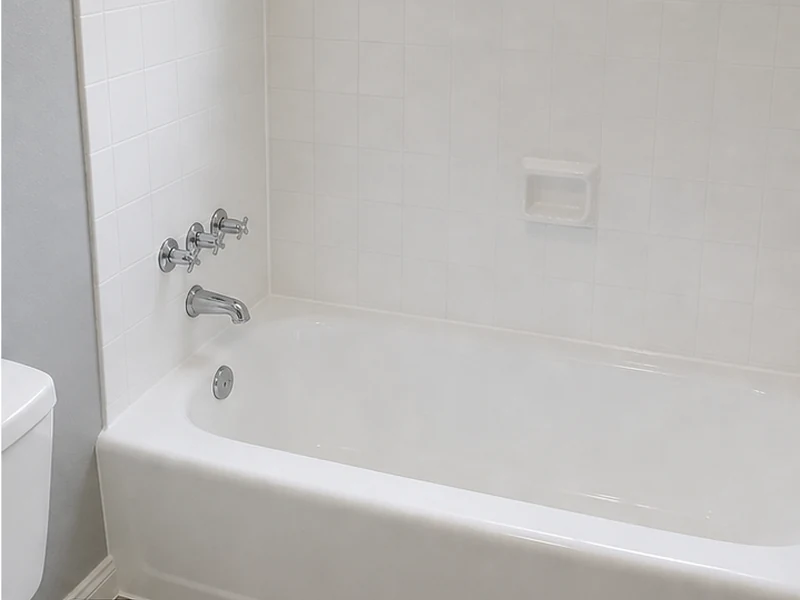
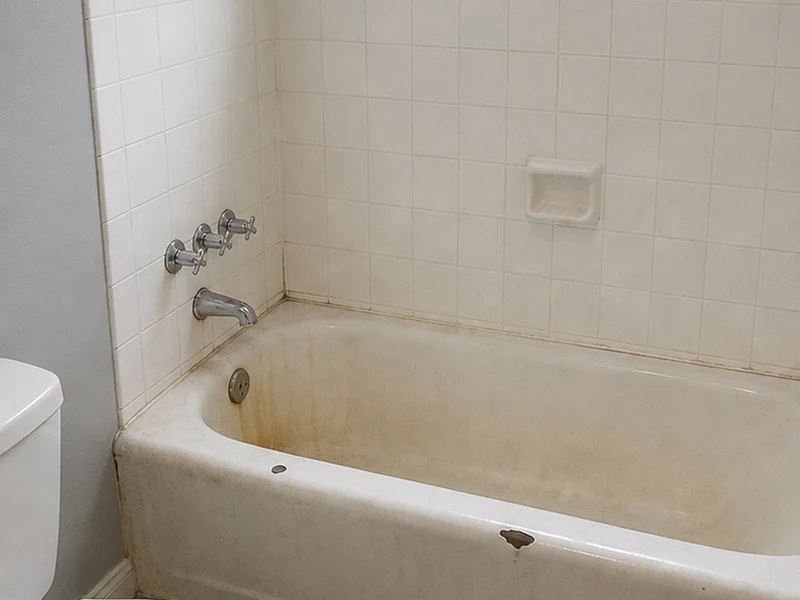
A 1958 cast-iron alcove tub in Fairway Park — rust around the drain, a chip at the rim, dulled enamel. Etched and resprayed in one afternoon, same camera angle, only the finish changed.
How porcelain and cast iron differ — and why the etch is everything
A cast-iron tub is a heavy iron casting with a fired porcelain enamel glaze; a steel tub is the same idea on thinner stamped steel. Both give a hard, glassy surface that is wonderful to bathe in and miserable to bond a coating to — porcelain is so smooth that paint and roll-on kits slide right off within months. The fix is an acid or silane etch that micro-roughens the enamel so a bonding primer can grip. That etch is the single most important step on a porcelain tub, and exactly what the cheap kits leave out.
The body underneath does not wear out. A cast-iron tub from the 1950s rings like a bell and outlasts the house. What fails is the glaze: years of bathing dull it, hard water stains it, and the moment a chip exposes the metal a rust spot starts and spreads from the drain or overflow. That doesn't mean the tub is finished — the surface needs renewing, which is what reglazing does.
Rust is the part you cannot shortcut. Once the metal is exposed it keeps oxidizing, and a coating laid over active rust just lifts as the rust grows underneath. We grind the rust back to clean, sound metal, treat it, and prime it before the topcoat goes on. That is the difference between a repair that lasts a decade and a stain that bleeds back through in a season.
Surface rust and rust-through are two different problems. Surface rust sits on the enamel or in a chip and grinds away to leave good metal behind — that is the common case at the drain and overflow, and it refinishes cleanly. Rust-through, where the iron or steel has corroded into an actual hole, is the honest limit: a pinhole can be filled and sealed, but a tub that has rotted through in several spots is structurally compromised and we'll recommend replacement instead of coating over a failing shell.
Why you don't move a cast-iron tub
A standard cast-iron alcove tub weighs three to four hundred pounds. Removing one means demolition around the surround, a new tub, tile repair and a plumber to reconnect it — days of work and four figures. We refinish it where it sits, and you keep the heavy, quiet, well-insulated tub that newer plastic units cannot match.
How do I tell if my tub is cast iron, steel or something else?
Three quick checks settle it. Tap the side: cast iron rings deep and long, stamped steel rings tinnier, fiberglass thuds dull. Hold a magnet to the wall — it sticks firmly to iron and steel, not to fiberglass or acrylic. And weight tells: a cast-iron alcove tub is 250–400 lb and does not move when you lean on the rim, while a steel or plastic tub gives a little.
- Tap test: deep ring = cast iron · lighter ring = steel · dull thud = fiberglass/acrylic.
- Magnet test: sticks hard to iron and steel; falls off fiberglass and acrylic.
- Weight: 250–400 lb and rock-solid = cast iron; lighter and slightly flexible = steel or plastic.
- Edge chip: a chip showing dark gray iron = cast iron; thin bright metal = steel.
It matters because the prep differs: porcelain over iron or steel is etched, while fiberglass and acrylic are scuff-sanded instead. Send a photo of a tap and a magnet on the rim and we'll confirm the material before quoting.
Refinishing vs re-porcelain (re-enameling) — what's the difference?
Re-enameling is a factory process: the tub is stripped bare, sprayed with powdered glass frit and fired in a kiln at roughly 1,500°F to fuse a new porcelain glaze. That can only happen with the tub removed and trucked out. On-site refinishing bonds an acrylic-urethane coat to the cleaned, etched enamel right where the tub stands.
For a built-in Hayward tub, on-site refinishing wins on every practical count. Re-enameling a 350-pound cast-iron tub means demolishing the surround to pull it, freight both ways to a shop with a kiln, and a plumber to reconnect it — easily multiples of a refinish, with the tub out of service for days or weeks. Refinishing is done in your bathroom in 3–5 hours and usable in 24–48.
| On-site refinishing | Factory re-enameling | |
|---|---|---|
| Tub removed? | No — done in place | Yes — stripped, freighted, kiln-fired |
| New surface | Bonded acrylic-urethane coat | Fused porcelain glaze (~1,500°F) |
| Time | 3–5 hrs; usable in 24–48 hrs | Days to weeks, tub out of service |
| Hayward cost | $700–$865 | Multiples of a refinish |
Can you match a vintage colored porcelain tub?
Yes. A lot of Hayward's mid-century bathrooms came with colored fixtures — the period pinks, mint greens, light blues and "biscuit" almond that filled 1950s and 1960s homes in Fairway Park and Glen Eden. We tint the acrylic-urethane topcoat to match an existing colored tub, or change it to a clean white or a modern neutral if you'd rather lose the dated shade.
Matching a vintage color works two ways. If you want to keep a coordinated colored bathroom and the tub is the only worn piece, we mix to the surviving color on the sink or tile so the refinished tub blends in. If the color is what's dating the room, white is the most common request — one even coat erases the old shade entirely. Either way the finish is sprayed, so there is no patchy roller streaking, just a uniform color across the whole tub.
Lead-safe work on Hayward's older cast-iron baths
The cast iron worth saving lives in Hayward's oldest housing — the pre-war and 1950s homes around Downtown Hayward, Mt. Eden and Glen Eden — and those are exactly the homes built before 1978, when lead-based paint was still in use. The fired porcelain inside the tub is glass and holds no lead; the risk is any brushed-on color on a painted exterior or an old painted wall the tub sits against. Federal law sets how a pro disturbs those surfaces: the EPA Renovation, Repair and Painting rule (40 CFR Part 745) calls for lead-safe practices, plastic containment, HEPA cleanup and testing before anything is sanded or ground. On a pre-1978 fixture, Alex Larkin assumes lead until a test clears it, masks and contains the room, and uses wet methods over dry sanding so lead dust never settles into grout, registers and carpet. A homeowner with an orbital sander on the same paint does the one thing the rule exists to prevent.
The coatings going back on are low-VOC acrylic-urethane systems that meet California Air Resources Board (CARB) limits, and the spraying falls under the Bay Area Air Quality Management District (BAAQMD) — the air regulator for Alameda County, not a Southern California district. An HVLP gun lays most of the material on the iron instead of into the air, and the overspray is contained inside the masked zone. See the full compliance and safety detail on our process page.
How we reglaze porcelain & cast iron, step by step
Reglazing a porcelain tub is mostly prep. The etch and the rust work are what make the finish last; the spray itself takes minutes.
- Mask and ventilate. Walls, floor and fixtures are taped off, overspray contained and ventilation run; old caulk and removable hardware come off.
- Deep-clean the enamel. Soap film, body oils and hard-water scale get scrubbed and stripped so the coating bonds to truly clean porcelain.
- Grind and treat rust. Rust at the drain, overflow and chipped edges is ground to clean metal, treated and stabilized so it cannot spread under the new finish.
- Fill chips and sand level. Chips exposing bare iron are filled and sanded dead level so they vanish under the topcoat.
- Acid/silane etch the porcelain. The enamel is micro-roughened so the bonding primer can grip the glassy surface — the step that makes the whole job stick.
- Prime and spray the acrylic-urethane topcoat. A bonding primer goes down, then several thin, even coats give a factory-smooth finish.
- Cure, re-caulk and hand it back. After the 24–48 hour cure window we lay fresh silicone and return a ready-to-use, warrantied tub.
Cast-iron and porcelain tubs across Hayward
Hayward's older housing is full of original cast iron — it is about 47% of the tubs we've sprayed here, roughly 615 cast-iron baths since 2011. The pre-war and 1950s homes in Mt. Eden, Glen Eden and the streets near Downtown Hayward still have their first tubs, and after sixty or seventy years the enamel is dull and the drain has a rust ring — the iron is perfect, the surface just needs renewing. In Fairway Park and Hayward Highlands we refinish 1950s–1960s cast-iron alcove tubs for owners refreshing a bathroom without a remodel; the tub comes back glossy white in a day. In the rental areas — Cherryland, Jackson Triangle, Harder-Tennyson, Southgate and Burbank — porcelain-over-steel tubs chip at the rim, so rust repair plus a respray is the routine turnover job; those steel tubs add another 245 or so to the count. We cover Hayward's 94541, 94542, 94544 and 94545 ZIPs.
What the finish handles — and what shortens its life
A properly etched and sprayed acrylic-urethane glaze handles daily bathing and normal cleaning for 10–15 years. What cuts that short is abrasive scouring powder, a suction-cup mat left stuck to the floor, and standing water from a dripping faucet on one spot. The written warranty covers peeling and adhesion failure rather than abuse. If your tub mainly needs a single chip, crack or rust spot addressed, see chip & crack repair.
Hayward customer reviews
★★★★★
Our 1958 cast-iron tub in Fairway Park had a rust ring at the drain and a chip you could feel with a toe. They ground out the rust, etched it, and sprayed it. Looks like a new tub and the chip is gone completely.
— Denise R., Fairway Park
★★★★★
The original porcelain tub in our Mt. Eden house was dull and stained. They explained the etch is what makes it stick — something the last guy who painted it clearly didn't do. This one is holding up beautifully.
— Albert C., Mt. Eden
★★★★★
I have steel tubs in my Harder-Tennyson rentals that chip and rust at the rim. They repair the rust and respray between tenants the same week. Way cheaper than swapping tubs out.
— Marcus T., Harder-Tennyson
Rated 4.8 / 5 across 356 Hayward reviews · Read more reviews →
Porcelain & cast-iron tub FAQ
Can you fix rust on a cast-iron or steel tub?
Yes. Once enamel chips, the exposed metal rusts and the stain spreads. We grind the rust back to clean, sound metal, treat it, and prime before the topcoat. Skipping that lets the rust keep eating under the new finish, so it is never just painted over.
What is the difference between reglazing, refinishing and resurfacing?
Nothing — all three name the same process of prepping the existing enamel and spraying a new bonded acrylic-urethane coating. It is different from a tub liner or a full replacement, which add a shell or tear the cast-iron tub out.
How do I tell if my tub is cast iron or steel?
Tap it and hold a magnet to it. Cast iron rings deep, weighs 250–400 lb and doesn't move; steel rings tinnier and gives slightly. A magnet sticks to both but falls off fiberglass or acrylic, which thud dully. A chip showing dark gray metal is cast iron.
What is the difference between refinishing and re-enameling?
Re-enameling fires a new porcelain glaze in a kiln, which means removing the tub and trucking it out. On-site refinishing bonds an acrylic-urethane coat in place in 3–5 hours for $700–$865. For a built-in cast-iron tub, refinishing in place is far cheaper and faster.
Can you match a vintage colored porcelain tub?
Yes. We tint the topcoat to match a period pink, mint, blue or almond on an existing colored tub, or change it to white or a modern neutral. The finish is sprayed, so the color comes out uniform with no roller streaking.
Why do DIY reglazing kits peel off porcelain?
Porcelain enamel is glassy, so roll-on kits that skip the acid etch and bonding primer slide off within months. A professionally etched, primed and sprayed finish grips the surface and lasts 10–15 years.
Do you offer a warranty, and are you licensed and insured?
Yes to both. Hayward Bath Refinishing & Resurfacing is fully licensed and insured, and every porcelain or cast-iron reglazing job carries a written 5-year warranty covering peeling and adhesion failure.
Local proof
Why this Porcelain Cast Iron Tub Refinishing page is specific to Hayward
This service page is tied to the fixtures we actually quote around Hayward: rental tub turns, fiberglass shower pans, cast-iron tub reglazing, and sink or tile refreshes. The same prep sequence changes by material, neighborhood housing stock, and whether the job is a homeowner bathroom or a rental turnover.
| Local situation | What we verify | Best next page |
|---|---|---|
| Fairway Park / Jackson Triangle older homes | Cast-iron or steel tub, rust at the drain, chipped rim, old caulk line | Porcelain and cast-iron tubs |
| Southgate / Glen Eden rentals and condos | Fiberglass flex, crazed gelcoat, failed DIY finish, fast turnover timing | Fiberglass and acrylic tubs |
| Burbank / Hayward Hills bathroom refreshes | Whether tub, tile, sink and counter should be bundled in one visit | Current price ranges |
- Photos help the quote: send the whole fixture, drain area, chips or cracks, and one photo of the bathroom layout before we schedule.
- Price context is visible: this page links to the current Hayward pricing, project examples, process, reviews and contact page instead of leaving the decision isolated.
- Local service path: if this is not the exact surface you need, the pages below point to the closest matching Hayward fixture guide.
Reglaze your Hayward porcelain or cast-iron tub
Open Mon–Sat 7 AM–6 PM. Free same-day quotes. Fully licensed & insured, with a written 5-year warranty.